Human Resources
Adding a User
You will be offered a list of all created users at the bottom in the Human Resources agenda. A person's detail will be displayed at the top after clicking on a specific user. It is necessary to state, for each employee, the beginning and (possibly) the end of employment. Click Add to add a new user. If you want to add more users at the same time, you can also perform a mass import.
Buttons and filters

After clicking the Human Resources agenda, the user is offered a tab with an overview of the employee. The agenda contains a list of all current and former employees.
A new employee record can be created using the +Add (1) button.
If the employee no longer performs work activity and it is not necessary to record his/her record in the Human Resources agenda, it is always recommended to set only the date in the End of employment field. If you decide to permanently Delete (2) the record, please note that you will delete all records associated with this account (attendance records, etc.). Once deleted, this action cannot be undone. You also have the option to permanently delete only specific employee records (profile photos, applications, attendance) using the Delete function by clicking the arrow next to the Delete sign.
After filling in the work email (tab 2 Contact), you have the option to Send email to the employees (only if you have the HR module enabled).
Once you have completed the employee's work email, you can Send system access invitation (3) to them. They will be sent an email with a link to create their login details.
If you need to quickly create multiple similar accounts or are handling a change in employment status (such as an employee transitioning from a part-time contract to a full-time contract), you can use the Duplicate button (4). It is visible to all users who have permission to edit the Human Resources module. After selecting a specific user and clicking the Duplicate button, you will be presented with two options:
a) Only duplicate the user - this action creates a new user with settings copied from the original one. The original user remains unchanged.
What is copied: Permissions, work schedules, photo, assigned departments, tags, contact information, etc.
What is NOT copied: Attendance, scheduled shifts, employee ID, and access methods (smart cards, fingerprints, QR codes, etc.)—these must be set up again for the new user.
When to use this: You are hiring 5 new part-time employees who will all have the same work schedule, the same vacation entitlement, and the same permissions, center, and tags. Set up the first one completely, then duplicate it 4 times, and for the newly duplicated profiles, simply edit the First Name, Last Name, and Personal ID.
b) Duplicate and delete original user - this option automatically terminates the original user’s employment on the specified date, and the duplicated copy (the new user) begins employment the following day.
Note: Attendance records or scheduled shifts entered after the employment end date will be automatically transferred from the original user to the newly created copy.
When to use this: Mr. Novák’s contract as a part-time employee ends on July 31, and he will transition to full-time employment starting August 1. Duplicate his record with the termination date set for July 31. This will create a new profile for him, effective August 1. If Mr. Novák has already clocked in on his old account during the first few days of August, the system will automatically transfer that attendance to his new profile.
In the individual print reports, which are available after pressing the button Print (5), you can export the list of employees, the list of permissions, or QR codes used to identify the user.
After the specified End of employment period, the employee's record is hidden. If you wish to view the record again, just click the Show only currently employed (6).
In the Human Resources agenda, you can search by the relevant column of the employee record. Therefore, if you click in any row in the “Surname” column in the upper right corner, a search by surname is available in the Search field (7). This function is available for each column of the table and the filtering parameters can be combined.
EXAMPLE: You want to search for all employees from the Expeditions centre who have a main employment contract.
- Click in any row in the Department column - type Expedition in the search box and press Enter
- Then click in any row in the Employment Type column - type Main employment contract in the search box and press Enter
This will give you a list of employees from Expedition who work on the Main employment contract.
Departments and sub-departments
It is possible to create a new department with the Add button by clicking in the department field in the 1 Basic card. A sub-department will be created if you have already clicked on a created department in the list and pressed the Add button.
Each user can be assigned to one or more departments once the departments are created. It is possible to specify user permissions according to the departments.

TIP: You can also assign users to departments in bulk. Simply mark specific people in the user list with checkmarks. Then, in the details of any person on tab 1 Basic, click on the magnifying glass icon next to Departments and select which department (or multiple departments) to add all of the checked ones to. Save your changes.
How to add a tag to your users
A lot of settings in the system are tied to departments or tags. Users can be tagged directly in HR, either individually or by bulk editing.

- In the HR agenda, use the checkboxes in the list of users to select the users to whom you want to add a new tag.
- On the 1 Basic tab, click in the Tags field and type any word(s) without spaces. Press Enter and the tag will be created next to the Tags field.
- Save your changes.
Once a tag has been created for someone, it will appear in the menu for other users.
An arrow can be clicked in the Tags field to display all tags used in the system. Click on a specific tag to make a selection. You can then save the changes.
TIP: You can also assign users to departments in bulk. Simply mark specific people in the user list with checkmarks. Then, in the details of any person on tab 1 Basic, click on the magnifying glass icon next to Departments and select which department (or multiple departments) to add all of the checked ones to. Save your changes.
How to assign PINs, chips, or fingerprints
If you want to assign PINs, chips, or fingerprints on your computer or on Attendance clocks, go through the instructions here.
Proceed as follows if you use QR codes for user identification
- In the Human Resources agenda - 5 Attendance card - It is necessary to manually enter at least one number in the Attendance PIN, chip, QR code 1 field for each user which will be used for a QR code creation afterward.
- Click on the Print button at the top after filling in this information and select the print report QR codes of employees for their generation.
User Login Before the Start and After the End of Employment
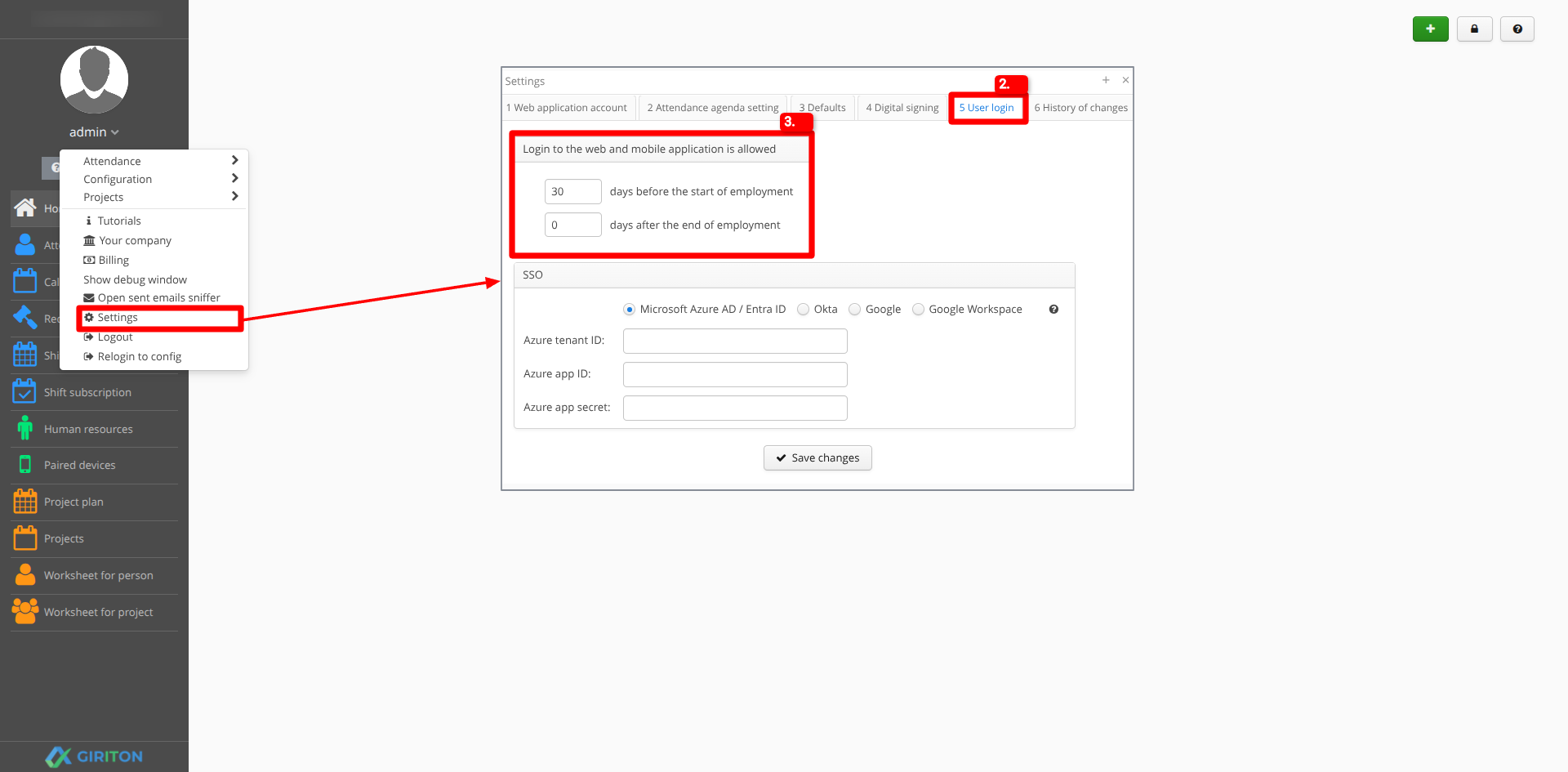
In the Giriton system, we have unified and streamlined the rules regarding whether and how far in advance before the start (or how long after the end) of employment employees can log into both the web and mobile applications.
This tool addresses situations where, for example, newly added workers (e.g., under temporary contracts/DPP) need to see or plan their shifts in the My Attendance app or the web interface even before their employment officially begins.
Where can you find the settings?
Menu path: Your name (top left) -> Settings -> tab 5. User Login
How does it work?
The following default rules now apply to both the web and mobile applications, and you can customize them as needed in the settings:
- Login before the start of employment: The default value is 30 days. This allows a new employee to log into the application a month in advance without any issues and plan their shifts in time.
- Login after the end of employment: The default value is 0 days. Access to the application is blocked immediately on the day the employment ends.
Important Notice (Security) If you decide to extend the period after the end of employment (e.g., so that a departing employee can check their attendance retroactively), we strongly recommend reviewing and adjusting their Permission Groups.
Ending the employment does not automatically change their rights (Permission Groups) in the system. If the user had higher permissions in the system (e.g., Team Leader or Manager), we recommend removing these permissions and leaving them with only basic access (e.g., the Employees with own attendance role).
Tip: If you need departing employees to have access to their attendance for, say, another 3 days after their employment ends to verify data, simply change the value to 3 days in the second option.